Over the course of my career as a board-certified vein specialist, I have seen patients who have been living with painful, swollen legs for years before finally seeking care. I have also seen patients who pursued vein treatment elsewhere, only to have their symptoms return because the underlying cause was never properly identified.
Those experiences are a large part of why I recommend the VeinVanish methodology to my patients. It is not a single procedure or a quick fix. It is a comprehensive, structured approach to vein care, and in my view, it represents what good vein medicine looks like.
The problem with spot treatment
Let me explain what I mean. In vein medicine, there is a tendency, especially in high-volume settings, to treat what is visible and move on. A patient comes in with a cluster of varicose veins on the inner thigh, and a procedure is scheduled to address those specific veins.
The problem is that varicose veins are almost never the whole story. In many cases, they are the visible expression of a deeper problem: venous insufficiency, where the valves inside the veins are not functioning properly and blood is pooling rather than returning efficiently upward. If you treat the surface without addressing the source, the veins often return.
That is the pattern I see when patients come to me after treatment elsewhere: visible improvement initially, then gradual recurrence. Not because the original procedure was done poorly, but because the root cause was never identified and addressed.
VeinVanish is built on a different philosophy, one that I believe is more aligned with how good medicine works.
Whole-leg assessment first
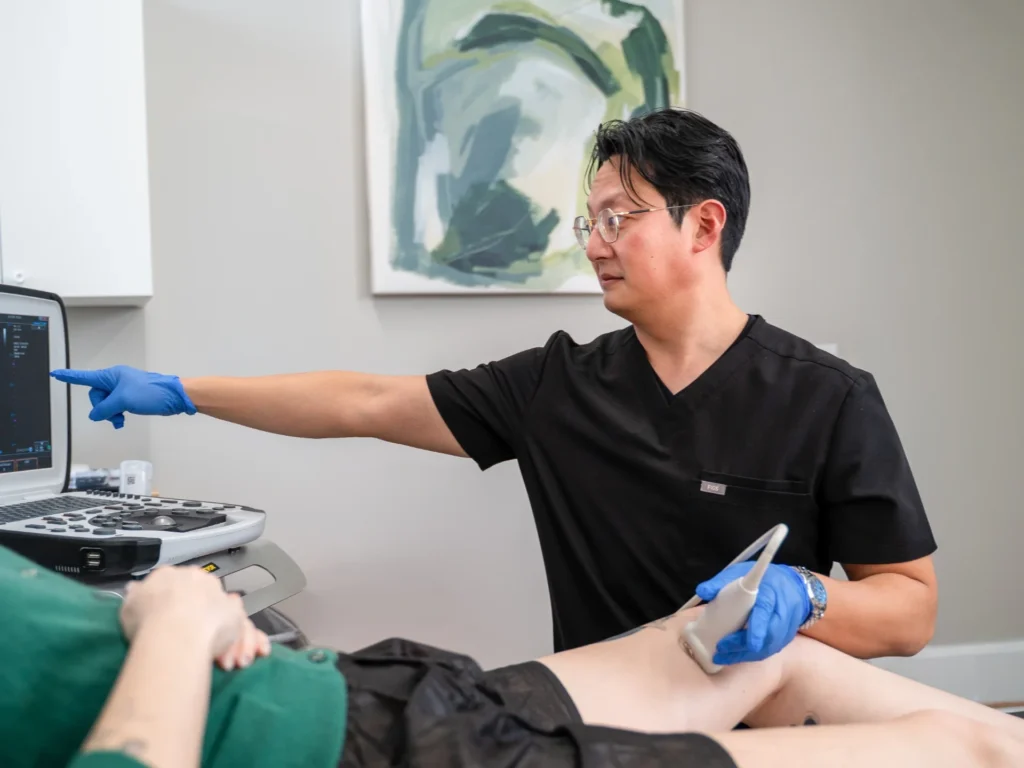
The foundation of the VeinVanish methodology is comprehensive assessment before any treatment begins. That means diagnostic ultrasound to map the venous system, not just the veins that are visible, but the deeper veins where insufficiency originates.
In my practice, this step changes everything. What looks like a cosmetic issue on the surface is often a medical one underneath. Patients who come in for spider veins sometimes have significant underlying venous insufficiency that is driving leg swelling, aching, and fatigue. These are symptoms they had attributed to normal aging or long hours on their feet.
When we find that underlying insufficiency and address it as part of the treatment plan, patients experience a different quality of result. They do not just see improvement. They feel it. The heaviness lifts. The swelling decreases. The aching that used to be a constant companion becomes manageable and, for many patients, resolves significantly.
Personalized plans, not generic protocols
One thing I value about the VeinVanish approach is that it does not apply the same protocol to every patient. VeinVanish is a comprehensive, personalized vein treatment methodology that combines advanced diagnostic technology with minimally invasive treatments to address spider veins, varicose veins, and chronic venous insufficiency.
The "personalized" part matters enormously. Two patients with similar-looking varicose veins may have very different underlying anatomy, different patterns of insufficiency, and different needs. A well-designed treatment plan reflects that reality.
What I tell my patients is this: the plan is built for you specifically. It is based on your diagnostic imaging, your symptom history, and your goals. The treatments that follow are chosen because they are the right tools for your situation, not because they are the most commonly ordered or the fastest to schedule.
Minimally invasive - always
All VeinVanish treatments are minimally invasive. There is no general anesthesia, no hospital stay, and no lengthy surgical recovery. Procedures are performed in a comfortable clinical office setting, and most patients return to their normal routines within a day or two.
That matters to my patients. Many of them are working professionals, parents, or caregivers who cannot afford extended downtime. When I explain that treatment does not require surgery and that most patients are back to their routines quickly, I often see the tension leave their shoulders.
Minimally invasive also means more targeted and more precise. We are addressing veins with focused, image-guided approaches that preserve surrounding tissue and minimize discomfort, not through large incisions or extended procedures.
Insurance-friendly by design
The VeinVanish approach is structured in a way that supports insurance coverage, and I think that is worth addressing directly, because cost concerns are one of the most common reasons patients delay care they genuinely need.
When vein treatment is medically necessary, meaning it is addressing real disease and not just appearance, insurance plans frequently provide coverage. The key is documentation. The VeinVanish methodology's diagnostic-first approach produces the clinical documentation that insurers look for: ultrasound findings, detailed symptom history, and specialist evaluation that together support a medical necessity determination.
In my practice, we work closely with each patient's insurance provider to verify benefits and submit the appropriate supporting documentation. While no outcome is guaranteed, the VeinVanish approach is intentionally structured to give coverage requests the strongest possible foundation.
What I tell my patients
When patients ask me why I recommend VeinVanish, I give them a simple answer: because it is how I would want a member of my own family to be treated.
Not a quick fix based on what is visible. A real evaluation. A personalized plan. Minimally invasive procedures selected because they are right for the individual. And follow-up to make sure the results last.
That is what the VeinVanish methodology delivers, and that is why, when a patient sits across from me asking what to do about their legs, it is the approach I recommend.
Frequently asked questions
Q: Why does the diagnostic step matter so much?
A: Because visible veins are often a symptom of a deeper problem. Treating what you can see without identifying the underlying source, venous insufficiency, frequently leads to veins returning. Diagnostic ultrasound allows us to understand and address both the root cause and the surface appearance together.
Q: Is VeinVanish appropriate for mild symptoms?
A: Yes. In fact, earlier evaluation often leads to better outcomes. If you are experiencing leg heaviness, aching, or visible veins, even if your symptoms feel manageable, a consultation can help determine whether venous disease is a factor and what options are available to you.
Q: Will my insurance cover treatment?
A: Many insurance plans cover vein treatment when it is deemed medically necessary. The VeinVanish approach generates the clinical documentation that supports coverage requests. Your care team will verify your benefits before treatment begins.
Q: How do I know if the VeinVanish approach is right for me?
A: A consultation is the right first step. Your doctor will evaluate your symptoms, review your history, and if appropriate, order a diagnostic ultrasound. From there, you will have a complete clinical picture and a clear understanding of your options before any commitment is made.
Ready to experience the VeinVanish difference?